Conferences & Workshops
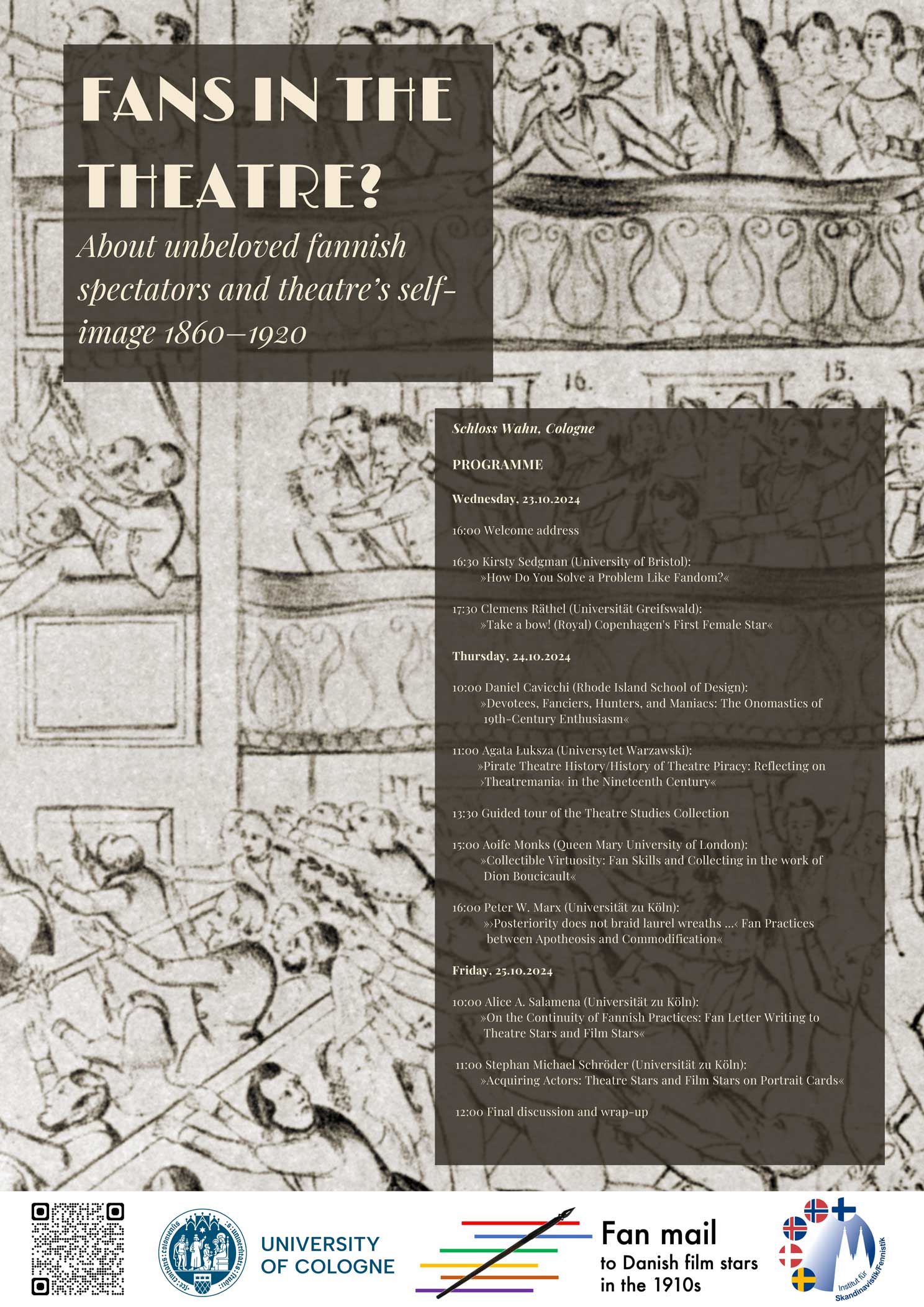
»Fans in the theatre? About unbeloved fannish spectators and theatre’s self-image 1860–1920«
- Date: 23.–25.10.2024.
- Location: Schloss Wahn, near Cologne.
Are there fans in the theatre, be it of individual actors and actresses, of the institution, of particular plays, or individual directors? Do fandom with its practices and the theatre have an important intersection that helps us better understand both the history of fandom and of theatre? The state of research is a timid, tentative ›yes‹ – tentative, because research has just begun to pay attention to this intersection: Fandom and the stage, Fandom Studies and Theatre Studies have seldom been related to each other. Although few in number, scholarly contributions have underlined the importance and topicality of the need to explore theatre and fans in interaction. The conference intends to contribute to this productive interdisciplinary border traffic by bringing the most distinguished scholars in this field into dialogue both with each other and with promising researchers of the younger generation.
For the conference programme and further information ▹ see here
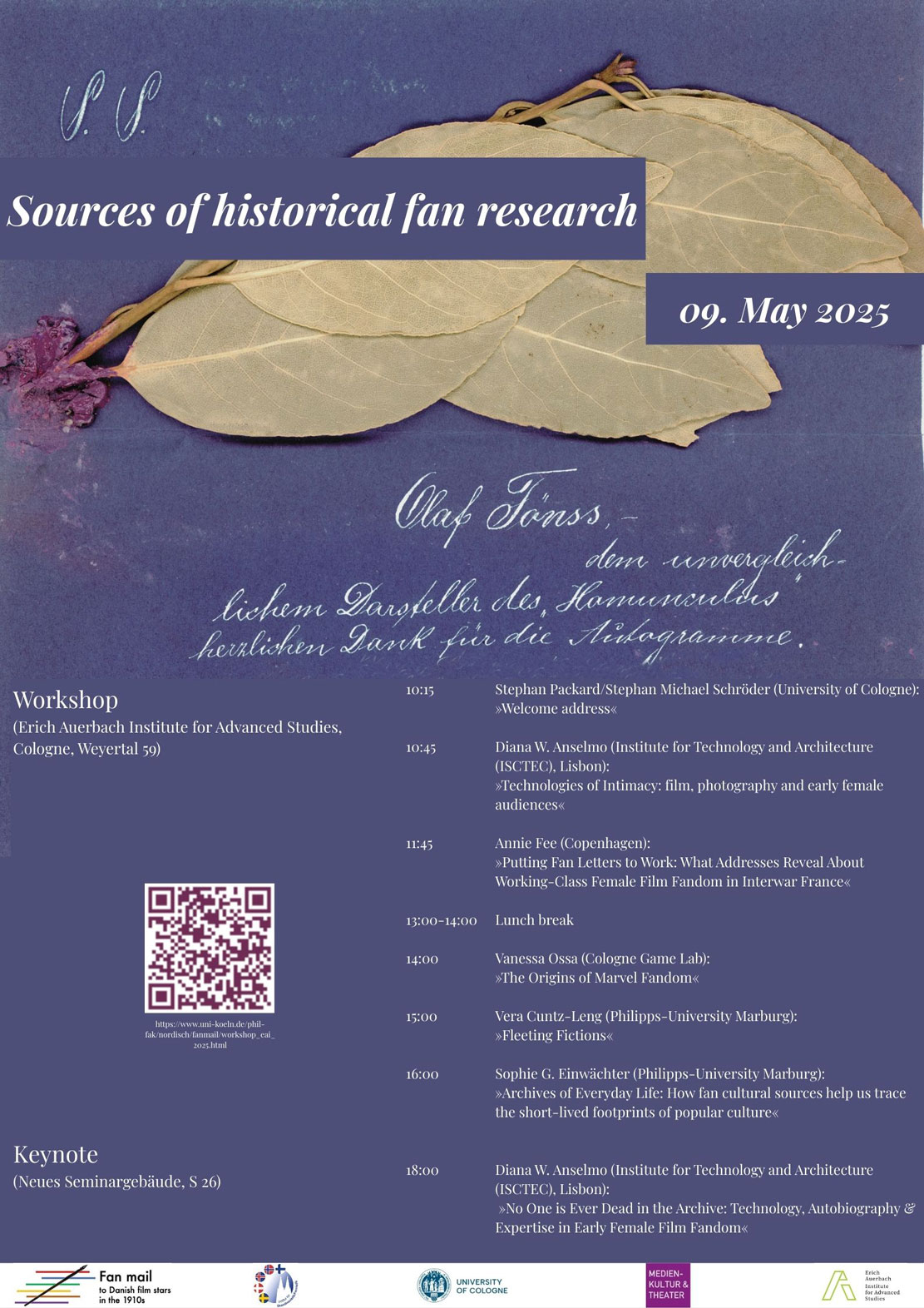
»Sources of historical fan research«
- Date: 9.5.2025.
- Location: Erich Auerbach Institute for Advanced Studies, Cologne.
Fan research tends to focus on contemporary fan cultures, mostly in the digital space. But how can we research historical fan cultures from the 19th century onwards? Which sources provide information about them? Which methodologies can be used to make them accessible? These questions will be discussed with guests from Germany and abroad at the workshop, which is being held in the context of a seminar at the University of Cologne.
For the conference programme and further information ▹ see here

Talk by Diana W. Anselmo and Corresponding Masterclass (in cooperation with Center for Media and Modernity Research, University of Cologne)
- Amuse Them Without Killing Them: Early Film Exhibition, Fire & Public Health (Talk, 28.10.2025, Seminargebäude, S 14, 18:00)
This talk focuses on the social and medical anxieties raised by the fast implementation of film exhibition infrastructures in early twentieth century Europe and United States. Structural failure due to fire became both a hazard and a spectacle in early cinema, with the UK and the US producing many successful »firebug« short films in the early 1900s. Simultaneously, fire became a main feature in shoddily constructed and retrofitted exhibition spaces. Flammable nitrate film, electrical short-circuiting, and overturned gas lamps ignited life-threatening blazes all over American movie houses, echoing previously devastating theater fires in France, US, China, and Portugal. In this talk I discuss how the fear of fire in early movie exhibition relates to a broader understanding of commercial cinema as a threat for public health that went beyond fears of structural failure into fears of airborne disease, female empowerment, democratic access, and social contagion.
- Letters from the Pacific: Race, Gender & Cultural Exchange in Silent Hollywood Fandom (Masterclass, 29.10.2025, 10:00, Fachschaftsraum Medienkultur)
Comparing the fan letters published in US movie magazines in the 1910s with those fans sent privately to early Hollywood stars, students will be asked to think through issues of gender, race, and cultural exchange taking place across different spheres of knowledge-production: the private and the public, the emotional and the commercial, home and abroad. Framed by a reading, a lecture, and in-class activities, students will learn about negative modes of fan participation forged at the onset of Hollywood's celebrity culture—including vitriol, snark, and tribalism—in order to better understand the long history of hostile patterns of engagement and relationality flourishing in online spaces today.

»Colloquium on Film Fan Culture in the Silent Era«
- Date: 6.8.2026.
- Location: Department of Scandinavian and Finnish Studies, Cologne.

(Evangeliemandens Liv (The Candle and the Moth, Denmark 1915), by courtesy of Danish Film Institute)